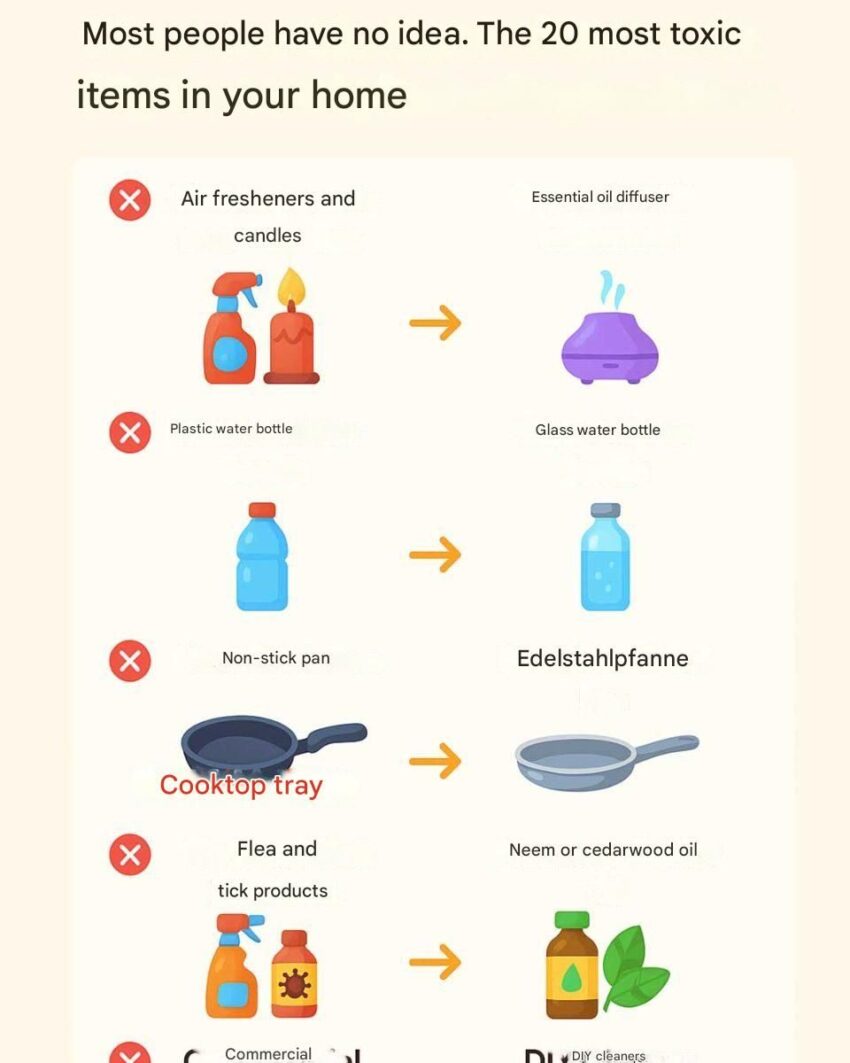
Most People Have No Idea: The 20 “Toxic” Items Commonly Found in Your Home (And What to Know About Them) 🏠⚠️
A science-based look at common household items that may contain chemicals of concern, how exposure actually works, and simple ways to reduce risk at home.
Walk through any home in the United States and you’ll see it everywhere—cleaning sprays under the sink, candles on the shelf, plastic containers in the kitchen, air fresheners in the hallway.
They all look harmless.
Some even smell “clean” or “fresh.”
But over the past decade, researchers, environmental health experts, and agencies like the U.S. Environmental Protection Agency (EPA) and academic institutions have raised an important point:
“Everyday exposure to certain household chemicals adds up over time.”
That doesn’t mean panic. It doesn’t mean throw everything out.
It means awareness.
Because in most cases, the issue isn’t a single item—it’s long-term, repeated exposure in poorly ventilated or overused environments.
This guide breaks down 20 commonly discussed household items that may contain ingredients or materials of concern, what the science actually says, and how to reduce exposure in a practical, realistic way.
Understanding “Toxic” in Context
Before listing anything, it’s important to clarify something experts emphasize:
The word toxic is often misunderstood online.
In toxicology:
“The dose makes the poison.” — Paracelsus
That means even water can be harmful in extreme amounts, while many everyday chemicals are safe at regulated exposure levels.
So in this article, “toxic” refers to:
- Ingredients linked to irritation or sensitivity
- Chemicals under scientific review
- Compounds that may pose risk with long-term or high exposure
- Products where safer alternatives exist
20 Common Household Items Often Flagged by Experts
1. Air fresheners (plug-ins and sprays)
Many contain volatile organic compounds (VOCs) that can irritate airways in sensitive individuals.
Concern: indoor air quality
Alternative: essential oil diffusers or ventilation
2. Scented candles (paraffin-based)
Some paraffin candles may release soot and trace compounds when burned in poorly ventilated spaces.
Better option: soy or beeswax candles
3. Non-stick cookware (older or damaged coatings)
When overheated, older non-stick coatings can release fumes.
Modern context: newer products are regulated, but condition matters.
4. Plastic food containers (low-grade plastics)
Certain plastics may release chemicals when exposed to heat.
Tip: avoid microwaving in plastic when possible.
5. Bottled water in plastic
Concerns often focus on microplastics and storage conditions.
6. Antibacterial soaps (certain formulations)
Overuse may contribute to skin sensitivity or bacterial resistance concerns (per FDA discussions).
7. Household cleaning sprays
Some contain ammonia or chlorine-based compounds that can irritate lungs if mixed improperly.
8. Laundry detergents with strong fragrances
Fragrance sensitivity is one of the most common household chemical complaints.
9. Fabric softeners
Often contain synthetic fragrances and coating agents.
10. Vinyl flooring
May contain plasticizers (phthalates), though regulations have changed over time.
11. Old paint (pre-1978 homes)
Lead-based paint is a serious known hazard in older housing stock (EPA guidance).
12. Pesticides and insect sprays
Designed to be biologically active—should always be used with caution and ventilation.
13. Pressed wood furniture
Some engineered wood products may emit formaldehyde in small amounts.
14. Personal care products with parabens (some formulations)
Used as preservatives; studied extensively for safety at regulated levels.
15. Dry-cleaned clothing (freshly returned)
May retain trace solvents if not properly aired out.
16. Old water pipes (lead plumbing risk)
Infrastructure-dependent risk in older homes.
17. Cheap synthetic air mattresses or furniture foam
Some may off-gas VOCs when new.
18. Nail polish and removers
Contain solvents that require proper ventilation.
19. Gas stoves (indoor air quality concerns)
Studies from environmental health groups have explored nitrogen dioxide exposure in poorly ventilated kitchens.
20. Mold in damp areas
Not a “product,” but a major household exposure issue.
Moisture control is key.
What the Science Actually Says (Important Reality Check)
Organizations like the EPA, CDC, and academic institutions generally agree:
- Most household products are safe when used as directed
- Risk increases with poor ventilation, overuse, or long-term exposure
- Children, elderly individuals, and those with asthma may be more sensitive
The real concern is not single exposure—it’s cumulative indoor air quality over time.
How to Reduce Exposure Without Overreacting
You don’t need to “purge” your home.
Instead, focus on simple upgrades:
1. Improve ventilation
Open windows when cleaning or cooking.
2. Choose fragrance-free products
Especially for detergents and sprays.
3. Use heat-safe food storage
Avoid heating food in low-quality plastic.
4. Maintain humidity control
Helps reduce mold growth.
5. Replace gradually, not instantly
Switch items as they wear out.
Real-Life Scenario
A typical U.S. household example:
- Uses air freshener daily
- Cleans with strong sprays weekly
- Cooks on gas stove without ventilation
- Stores food in plastic containers
Individually, each is common and generally low-risk.
Combined, over years, they may affect indoor air quality and sensitivity in some individuals.
Small changes—like ventilation and switching to fragrance-free products—often make a noticeable difference in comfort.
Pros and Cons of Awareness-Based Living
Pros
- Better indoor air quality
- Reduced irritation for sensitive individuals
- More mindful consumption
- Often healthier overall habits
Cons
- Can lead to unnecessary fear if misunderstood
- Requires small lifestyle adjustments
- Not all “natural” alternatives are safer by default
Common Mistakes People Make
1. Overreacting to individual items
Risk is usually cumulative, not isolated.
2. Assuming “natural” always means safe
Some natural substances are highly irritating too.
3. Ignoring ventilation
Airflow matters more than most products.
Expert Perspective
Environmental health experts often emphasize a balanced approach:
- Focus on exposure reduction, not elimination
- Prioritize ventilation and cleanliness
- Pay attention to sensitivity symptoms (headaches, irritation)
- Follow regulated safety guidelines
FAQs
1. Are all household products toxic?
No. Most are safe when used correctly and in moderation.
2. Should I throw everything out?
No—gradual replacement is more practical.
3. What is the biggest indoor air risk?
Poor ventilation combined with chemical use.
4. Are natural cleaning products safer?
Not always, but many are gentler on sensitive individuals.
5. Do air purifiers help?
Yes, they can reduce airborne particles in indoor environments.
6. Is plastic food storage dangerous?
It depends on type, age, and how it’s used.
7. Are scented candles harmful?
Only a concern with heavy, poorly ventilated use.
8. What’s the easiest first change?
Switching to fragrance-free cleaning products.
Your home doesn’t need to become a sterile, chemical-free space.
But understanding what’s in everyday products gives you something powerful: control through awareness.
Most household risks aren’t dramatic or immediate—they’re subtle, long-term, and often manageable with small changes.
And in most cases, improving ventilation and reducing unnecessary fragrance use already makes a noticeable difference.
Many common household items contain ingredients worth being aware of, but real-world risk depends on exposure, usage habits, and ventilation—not panic. Small, informed changes are usually enough to create a safer, more comfortable home environment.
If this made you look around your home a little differently, share it with someone who loves home cleaning hacks—and wants a more informed approach to everyday living.