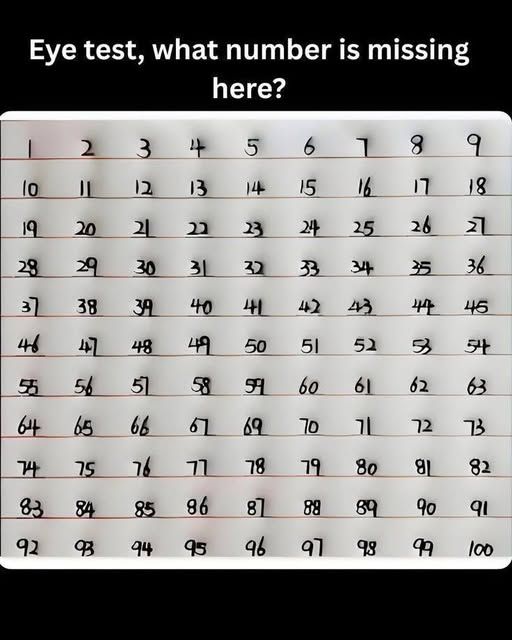
Eye Test: Find the Missing Number – Only 1 in 10 People Get It Right on the First Try
Test your brain with this eye test missing number puzzle. Learn patterns, logic tricks, and how to solve number sequences faster and smarter.
Why “Find the Missing Number” Puzzles Are So Addictive
You’ve probably seen them online:
A sequence of numbers… one number missing… and a bold claim:
“Only 1 in 10 people can solve this!”
You pause for a second. It looks simple. Almost too simple.
Then your brain starts working:
- Is it addition?
- Multiplication?
- A pattern I’m missing?
- Wait… what if it’s alternating?
This is exactly why “eye test” missing number puzzles go viral — they create a mental tension between simplicity and hidden complexity.
And that’s not accidental.
These puzzles are designed to test something very real:
👉 How your brain recognizes patterns under pressure
What This Puzzle Type Actually Tests (It’s Not Just Math)
Despite the name “eye test,” this isn’t about eyesight.
It’s about:
🧠 Pattern recognition
Your brain’s ability to detect structure in data.
⚡ Cognitive speed
How quickly you eliminate wrong possibilities.
🔍 Attention to detail
Whether you notice subtle changes in sequence logic.
🎯 Logical flexibility
Your ability to switch strategies when one doesn’t work.
According to cognitive psychology research, humans rely heavily on “mental shortcuts” called heuristics. These help us solve problems quickly — but sometimes they also lead us to miss hidden patterns.
That’s why these puzzles feel easy… until they suddenly don’t.
The Basic Structure of Missing Number Eye Tests
Most of these puzzles follow a familiar format:
2, 4, 8, 16, ?, 64
or
3, 6, 12, 24, ?, 96
At first glance, it feels obvious.
But the challenge is that there are multiple possible patterns, and only one is correct based on the intended logic.
Step-by-Step Method to Solve Any Missing Number Puzzle
Instead of guessing, use a structured approach.
Step 1: Check simple arithmetic first
Ask:
- Is it addition?
- Is it subtraction?
Example:
2, 4, 6, 8, ?
Pattern: +2 → Answer: 10
Step 2: Check multiplication patterns
Example:
3, 6, 12, 24, ?
Pattern: ×2 → Answer: 48
Step 3: Look for alternating patterns
Example:
1, 3, 2, 6, 3, 9, ?
Here:
- Odd positions: 1, 2, 3, 4…
- Even positions: 3, 6, 9…
So answer depends on position logic.
Step 4: Check differences between numbers
Example:
5, 10, 18, 29, ?
Differences:
- +5
- +8
- +11
Pattern: increasing by +3 each time → next difference +14 → Answer: 43
Step 5: Look for hidden operations
Some puzzles combine:
- Squares
- Cubes
- Prime numbers
- Mixed operations
Example:
1, 4, 9, 16, ?, 36
These are perfect squares:
1², 2², 3², 4², 5², 6² → Answer: 25
Let’s Try a Real Eye Test Puzzle
Try solving this:
🔢 Puzzle:
7, 14, 28, 56, ?, 224
Take a moment.
Don’t rush.
🧠 Solution:
Each number is multiplied by 2:
- 7 × 2 = 14
- 14 × 2 = 28
- 28 × 2 = 56
- 56 × 2 = 112
- 112 × 2 = 224
👉 Missing number = 112
Why Most People Get These Wrong
Even though these puzzles look simple, mistakes happen for predictable reasons.
❌ 1. Overthinking too early
People assume complexity before checking basic patterns.
❌ 2. Fixating on one rule
Once the brain picks a pattern, it resists changing it.
❌ 3. Ignoring position-based logic
Some sequences alternate rules.
❌ 4. Rushing under pressure
Time limits reduce accuracy.
The Psychology Behind “Only 1 in 10 Get It Right”
That phrase is not always literal.
It works because of:
🔥 Curiosity trigger
People want to prove they are part of the “smart group.”
🧠 Ego engagement
We naturally want to solve puzzles others struggle with.
📱 Social comparison
Sharing results increases engagement online.
Platforms like social media and quiz blogs use this because it dramatically increases interaction time.
Common Types of Missing Number Patterns
Let’s break them down clearly.
1. Arithmetic sequences
Simple addition or subtraction.
Example:
4, 8, 12, 16, ?
Answer: 20
2. Geometric sequences
Multiplication or division.
Example:
2, 6, 18, 54, ?
Answer: 162
3. Square numbers
Example:
1, 4, 9, 16, ?
Answer: 25
4. Cube numbers
Example:
1, 8, 27, 64, ?
Answer: 125
5. Mixed logic puzzles
Example:
2, 5, 10, 17, 26, ?
Differences:
+3, +5, +7, +9 → next +11
Answer: 37
6. Position-based puzzles
Odd/even pattern splits.
A More Challenging Eye Test Puzzle
Try this one:
🔢 Puzzle:
10, 12, 16, 22, 30, ?
🧠 Step-by-step:
Differences:
- +2
- +4
- +6
- +8
Pattern increases by +2 each time.
Next difference = +10
👉 Answer: 40
Real-Life Use of These Brain Tests
You might wonder: why do these matter?
They’re used in:
- IQ-style assessments
- Job aptitude tests
- Cognitive training apps
- Educational tools
- Brain training games
They are not perfect measures of intelligence, but they do test:
- Logical thinking
- Focus
- Pattern recognition speed
How to Get Better at These Puzzles
If you want to improve, don’t memorize answers — train your thinking process.
✔ Practice daily
Even 5–10 puzzles a day helps.
✔ Learn common patterns
Most puzzles repeat similar structures.
✔ Slow down at first
Speed comes after accuracy.
✔ Write steps down
Visually mapping numbers improves clarity.
Advanced Trick Most People Don’t Notice
Some puzzles are designed to mislead you intentionally.
Example:
1, 2, 4, 7, 11, ?
Most people try multiplication.
But correct pattern is:
+1, +2, +3, +4 → next +5 → Answer: 16
👉 The trick: always check differences first, not assumptions.
Why Your Brain Enjoys These Challenges
Your brain releases a small dopamine reward when you solve patterns.
That’s why:
- You feel satisfaction after solving
- You want to try another one
- You share it with others
It’s the same mechanism behind:
- Sudoku
- Crosswords
- Logic games
Frequently Asked Questions
1. What is a missing number eye test?
It is a puzzle where you identify the missing number in a sequence using logic or patterns.
2. Are these puzzles IQ tests?
Not officially, but they test similar reasoning skills.
3. Why do I find them difficult sometimes?
Because multiple patterns can exist, and your brain may choose the wrong one first.
4. Can practice improve performance?
Yes, significantly. Pattern recognition improves with repetition.
5. What is the most common pattern used?
Multiplication, addition, and square numbers are most common.
6. Are these used in exams?
Yes, in aptitude tests and competitive exams.
7. Why do people share “only 1 in 10 solve it” posts?
To increase curiosity and engagement.
8. What is the fastest way to solve them?
Check differences first, then multiplication patterns.
9. Do these puzzles measure intelligence?
They measure specific reasoning skills, not overall intelligence.
10. Can kids solve these puzzles?
Yes, many are designed for educational use.
Final Thoughts: It’s Not About the Number — It’s About the Thinking
Missing number puzzles are more than just online entertainment.
They’re small mental workouts that reveal how your brain approaches problems:
- Do you rush or analyze?
- Do you stick to one idea or adapt quickly?
- Do you notice simple patterns or overcomplicate them?
There is no “right type of thinker.”
Just different ways of seeing structure.
And that’s what makes these puzzles so interesting — not the number you find, but how you find it.
Eye test missing number puzzles are a fun and effective way to sharpen logical thinking and pattern recognition. While they don’t measure intelligence, they do reveal how your brain processes information under simple but tricky conditions.
If you enjoyed this challenge, try more — your brain gets better every time you do.