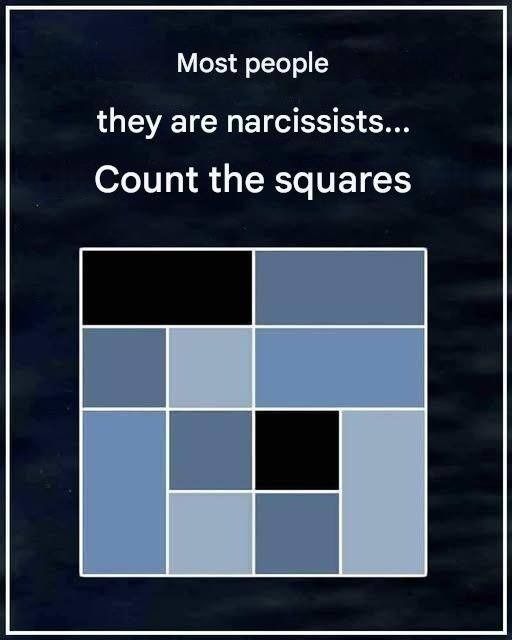
Why “Most People Are Narcissists” Falls Apart—And What a Simple “Count the Squares” Puzzle Reveals About Human Thinking
A viral claim says most people are narcissists—but psychology says otherwise. A “count the squares” puzzle reveals how perception really works.
The Claim That Sounds True… But Isn’t
At some point online, you’ve probably seen a bold statement:
“Most people are narcissists.”
It’s the kind of phrase that spreads fast because it feels emotionally satisfying. It explains difficult relationships. It labels frustrating behavior. It gives a simple answer to a complicated world.
But psychology doesn’t support it.
And more importantly, it reveals something deeper about how humans think—not just about personality, but about reality itself.
To understand that, there’s a simple visual puzzle often called the “count the squares” problem. It looks easy. Almost childish. But it exposes the exact same mental shortcuts that make oversimplified ideas like that narcissism claim feel believable in the first place.
Let’s unpack both.
First: The Narcissism Myth—What Psychology Actually Says
Narcissism exists on a spectrum. In clinical psychology, there’s a diagnosable condition called Narcissistic Personality Disorder (NPD), but that is rare in the general population.
What’s more common is something else:
- Occasional self-centered behavior
- Confidence mixed with insecurity
- Situational ego-driven decisions
These are human traits, not a disorder.
The key misunderstanding
When people say “everyone is a narcissist,” they’re usually confusing:
- Confidence with arrogance
- Self-protection with manipulation
- Healthy boundaries with selfishness
Psychology research does not support the idea that “most people” meet clinical criteria for narcissism.
In fact, large-scale estimates generally place diagnosable NPD in a small minority of the population.
So why does the myth feel so convincing?
Because your brain, like everyone else’s, relies on shortcuts.
And that brings us to the puzzle.
The “Count the Squares” Puzzle That Tricks Almost Everyone
Look at a simple grid of squares (commonly a 4×4 or 5×5 arrangement in puzzle form).
The question is:
How many squares are there in total?
Most people glance at it and quickly answer something like:
- “16” (counting only the small squares)
or - “25” (if it’s a 5×5 grid)
Both answers feel correct at first.
But both are incomplete.
Because the puzzle isn’t just about small squares—it includes:
- Small squares
- Medium squares
- Large squares
- Overlapping square combinations
What makes this tricky is that your brain automatically prioritizes the most obvious pattern.
Just like with social assumptions.
Why Your Brain Misses the Full Picture
Your mind is constantly doing something incredibly efficient:
It simplifies complexity into recognizable patterns.
This is called pattern recognition, and it’s essential for survival.
But it comes with a cost.
What happens when you see the square grid:
- Your brain identifies the smallest repeating unit
- It assumes that’s the full answer
- It stops searching for deeper structure
You don’t notice what you don’t immediately see.
That’s not laziness—it’s efficiency.
But it leads to systematic blind spots.
Let’s Solve It Properly (Step-by-Step)
To understand how perception fails, let’s walk through a standard 4×4 grid example.
Step 1: Count 1×1 squares
There are:
- 16 small squares
Step 2: Count 2×2 squares
Now look for blocks of four:
- 9 squares
Step 3: Count 3×3 squares
Larger blocks:
- 4 squares
Step 4: Count 4×4 square
The entire grid:
- 1 square
Final total:
16 + 9 + 4 + 1 = 30 squares
Most people initially say 16 or 25.
Very few get it right without slowing down.
And that gap between “what feels obvious” and “what is actually true” is the entire lesson.
The Connection Between the Puzzle and Human Judgment
Now here’s where it gets interesting.
The same mental shortcut that makes you underestimate the number of squares is the same one that makes broad claims like:
“Most people are narcissists”
feel believable.
Your brain:
- Sees a few examples of selfish behavior
- Groups them into a pattern
- Expands that pattern to “most people”
- Stops checking alternative explanations
It’s the same cognitive process.
Different topic. Same mechanism.
Why This Happens: The Psychology of Mental Shortcuts
Human cognition uses something called heuristics—mental shortcuts that help us make fast decisions.
While useful, they create predictable errors:
1. Availability bias
You judge frequency based on what you easily recall.
If you recently had a conflict with someone selfish, it feels “common.”
2. Confirmation bias
You notice evidence that supports your belief and ignore what doesn’t.
3. Pattern overgeneralization
You assume a pattern applies broadly after seeing a few examples.
4. Emotional reasoning
If something feels true, your brain treats it as more likely to be true.
Why This Matters in the United States Today
In the U.S., where social media, fast news cycles, and constant opinion sharing dominate attention, these cognitive shortcuts are amplified.
This affects:
Relationships
People quickly label others as “toxic” or “narcissistic” based on limited interactions.
Workplaces
Misunderstandings escalate because intent is assumed rather than clarified.
Online discourse
Complex human behavior gets reduced into simple labels.
Mental health conversations
Clinical terms are often used casually, diluting their meaning.
The result is a world where simplification replaces understanding.
A More Accurate Way to Think About People
Instead of labeling people as “narcissists” or not, psychology encourages a spectrum-based view:
- Empathy varies by situation
- Self-interest fluctuates depending on stress
- Behavior changes with context
Most people are not fixed types.
They are adaptive systems responding to circumstances.
Mini Case Study: The Misread Coworker
Imagine a workplace scenario:
A colleague doesn’t help you with a project deadline.
You think:
“They’re selfish. Probably narcissistic.”
But later you learn:
- They were covering for another emergency task
- They were dealing with personal stress
- They assumed someone else was helping you
Your initial interpretation wasn’t malicious—it was incomplete.
Just like counting only the small squares.
Expert Insight: Why Smart People Fall for This Too
Research in cognitive science shows something important:
Intelligence does not eliminate bias—it often improves justification.
That means highly intelligent people:
- Notice patterns quickly
- But may trust those patterns too early
- Then build strong arguments around incomplete assumptions
So the issue isn’t intelligence.
It’s how the brain filters reality before reasoning even begins.
Common Mistakes People Make in Judgment
1. Jumping from behavior to identity
One action becomes a permanent label.
2. Ignoring context
Without context, behavior is misunderstood.
3. Overconfidence in first impressions
The brain prefers fast answers over accurate ones.
4. Emotional labeling
Strong feelings replace careful analysis.
The Deeper Lesson of the Square Puzzle
The puzzle teaches something quietly profound:
Reality is often larger than your first interpretation of it.
You don’t see all the squares at first glance.
And you don’t see all the reasons behind human behavior at first impression either.
Practical Ways to Improve Your Thinking
You don’t need advanced training to reduce these errors. You just need small habits:
1. Slow down interpretations
Especially when emotions are involved.
2. Ask “What am I missing?”
This single question expands perspective.
3. Separate behavior from identity
Instead of “They are X,” think “They did Y.”
4. Consider at least two alternative explanations
Even if one feels obvious.
5. Re-check your first conclusion
Your first answer is often incomplete, not wrong—but partial.
Future Outlook: Why This Skill Matters More Than Ever
As digital content increases, the brain faces more:
- Information overload
- Emotional triggers
- Simplified narratives
- Viral misinformation
The ability to think beyond first impressions is becoming less of an advantage—and more of a necessity.
FAQs (People Also Ask Style)
1. How many squares are actually in the puzzle?
In a standard 4×4 grid, there are 30 total squares of different sizes.
2. Why do people get the wrong answer?
Because the brain focuses on the most obvious pattern first.
3. Does this mean humans are irrational?
No. It means the brain prioritizes speed over perfect accuracy.
4. Is it true that most people are narcissists?
No. That is a misunderstanding of psychological terms and behavior.
5. What does the puzzle teach us?
It shows how easily we miss hidden structure in complex systems.
6. Can this affect decision-making?
Yes, especially in social judgment, work, and financial choices.
7. Why does my brain simplify things automatically?
To reduce cognitive load and make fast decisions.
8. Is this related to cognitive bias?
Yes, several biases contribute to this effect.
9. How can I improve my perception?
By slowing down, questioning assumptions, and checking alternatives.
10. Why does this feel so surprising?
Because your brain is rarely aware of its own shortcuts.
Action Checklist: Sharpening Your Perception
- ☐ Avoid quick labeling of people
- ☐ Re-check first impressions
- ☐ Look for missing elements in situations
- ☐ Ask alternative explanations
- ☐ Separate emotion from interpretation
- ☐ Slow down in high-stakes decisions
- ☐ Practice “counting the hidden squares” in real life
Conclusion: What You Don’t See Still Shapes Your Reality
The “count the squares” puzzle isn’t about geometry.
It’s about awareness.
And the claim that “most people are narcissists” isn’t just incorrect—it’s a reminder of how easily the human mind turns partial patterns into complete truths.
In both cases, the issue isn’t what’s present.
It’s what gets overlooked.
The real skill isn’t seeing faster—it’s seeing deeper.
Because in life, just like in the puzzle, the full picture is almost always larger than your first answer.
Your mind is fast—but it simplifies reality.
Clarity comes from learning to see beyond that first layer.
If this made you rethink how you judge people or interpret situations, it’s worth sharing—or better yet, try the square puzzle with someone else and see what they notice first.