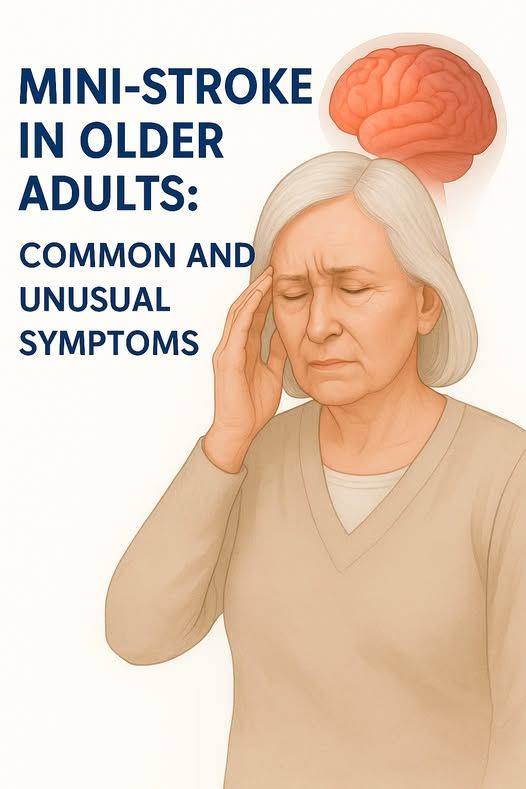
5 Critical Health Signals of a Mini Stroke in Seniors That Shouldn’t Be Ignored
Learn the 5 critical warning signs of a mini stroke in seniors, how to recognize them early, and why immediate action can prevent life-threatening complications.
When “It Passed Quickly” Could Be the Most Dangerous Sentence You Hear
A mini stroke often feels like a strange contradiction.
One moment, everything seems normal. The next, something feels “off” — speech is slightly slurred, one arm feels weak, or vision blurs for a few seconds. And then, just as quickly as it came, it disappears.
That sudden disappearance is exactly why so many families in the United States underestimate it.
They say things like:
- “It went away, so it must be nothing.”
- “Maybe it was just fatigue.”
- “They seem fine now.”
But here’s the truth medical experts stress repeatedly: a mini stroke, also known as a transient ischemic attack (TIA), is not a harmless episode. It is often the body’s loudest warning sign that a full stroke may be imminent.
According to health organizations like the American Stroke Association, up to 1 in 3 people who experience a TIA may go on to have a major stroke, often within days or weeks if untreated.
For seniors — especially those over 60 — recognizing these early signals can literally mean the difference between recovery and permanent disability.
This article breaks down the 5 critical health signals of a mini stroke in seniors in a way that is practical, real-world, and easy to remember. No fear tactics — just clarity, awareness, and life-saving understanding.
Why Mini Strokes Are a Growing Concern in the United States
Before diving into symptoms, it’s important to understand why this issue matters so much in American households today.
The United States has an aging population, and with age comes increased risk for cardiovascular and neurological events. Conditions like high blood pressure, diabetes, obesity, and sedentary lifestyles all contribute to higher stroke risk.
A few important facts:
- Stroke is a leading cause of long-term disability in the U.S.
- Seniors over 65 are at the highest risk group
- Many mini strokes go unreported or unnoticed
- Early intervention can significantly reduce future stroke risk
The challenge isn’t just medical — it’s awareness. Many seniors experience symptoms briefly and assume they are insignificant.
But a mini stroke is never “just a moment.”
It is a warning.
Understanding a Mini Stroke (TIA) in Simple Terms
A mini stroke occurs when blood flow to part of the brain is temporarily blocked. Unlike a full stroke, the blockage clears on its own — often within minutes to a few hours.
However, even short interruptions can:
- Disrupt brain function
- Signal underlying artery blockage
- Indicate increased clot risk
Think of it like a warning light in a car. The light may turn off temporarily, but the engine problem still exists.
5 Critical Health Signals of a Mini Stroke in Seniors
1. Sudden Weakness or Numbness on One Side of the Body
This is one of the most recognizable — and most dangerous — warning signs.
A senior may suddenly experience:
- Weakness in the arm, leg, or face
- Numbness on one side of the body
- Drooping facial muscles
- Difficulty holding objects
Why it happens
When blood flow to the brain is briefly interrupted, the areas responsible for movement and sensation are affected.
Real-life example
A daughter in Ohio noticed her father suddenly dropping his coffee cup with his right hand. Within minutes, he felt “fine again.” He refused to go to the hospital.
Two days later, he suffered a full stroke.
This pattern is common — and preventable.
2. Temporary Speech or Language Difficulties
Another major warning sign involves sudden changes in communication.
This may include:
- Slurred speech
- Trouble finding words
- Speaking incoherently
- Difficulty understanding others
What families often miss
Many assume it’s:
- Fatigue
- Medication side effects
- Stress or confusion
But in reality, speech centers in the brain are extremely sensitive to oxygen loss.
Even a brief interruption can cause noticeable changes.
Important note
If speech changes suddenly and without explanation — even if it resolves quickly — it should always be treated as urgent.
3. Sudden Vision Changes or Loss
Vision problems during a mini stroke can appear in different ways:
- Blurred vision
- Double vision
- Temporary loss of vision in one eye
- “Curtain falling” sensation over sight
Why it matters
The brain processes vision through multiple pathways. A TIA can temporarily disrupt these pathways, creating sudden visual disturbances.
Common mistake families make
Many seniors assume:
- “I just need glasses adjustment”
- “My eyes are tired”
But neurological vision changes feel different from eye strain — they come suddenly and unpredictably.
4. Sudden Dizziness, Loss of Balance, or Coordination Issues
This symptom is often mistaken for:
- Vertigo
- Inner ear issues
- Low blood pressure
But during a mini stroke, the brain areas responsible for balance are temporarily affected.
Signs to watch for
- Sudden stumbling
- Difficulty walking straight
- Feeling like the room is spinning
- Sudden loss of coordination
Why seniors are especially vulnerable
As we age, balance systems naturally weaken. A TIA can amplify this weakness instantly.
5. Sudden Severe Headache Without Clear Cause
While not always present, a sudden intense headache can be a warning signal — especially if it feels unusual for the person.
Characteristics include:
- Sudden onset
- No known trigger
- Different from usual headaches
- May feel intense or “explosive”
Important clarification
Not all mini strokes cause headaches. But when they do occur, they should never be ignored.
The FAST Rule Every Family Should Know
Medical professionals often recommend the FAST method for quick recognition:
- F – Face drooping
- A – Arm weakness
- S – Speech difficulty
- T – Time to call emergency services
In the United States, calling 911 immediately is critical. Even if symptoms disappear, evaluation is still necessary.
What Happens After a Mini Stroke? (The Reality Most People Don’t Hear)
Even if symptoms resolve, a TIA is a major warning sign.
Doctors may recommend:
- Brain imaging (CT or MRI)
- Blood pressure monitoring
- Cholesterol evaluation
- Medication to prevent clots
- Lifestyle changes
The goal is not just treatment — it is prevention of a future, potentially disabling stroke.
Common Mistakes Families Make
1. Waiting for symptoms to return
A TIA often does not repeat before a major stroke.
2. Assuming recovery means safety
Temporary recovery does not mean the risk is gone.
3. Ignoring mild symptoms
Even subtle changes matter.
4. Self-diagnosing at home
Online searches cannot replace medical evaluation.
Expert Insight: Why Speed Matters
Neurologists consistently emphasize one key message:
“Time lost is brain lost.”
The faster a mini stroke is evaluated, the higher the chance of preventing a full stroke.
Early treatment can significantly reduce risk — sometimes by more than 80% when addressed promptly.
Mini Case Scenario: A Preventable Stroke
A 72-year-old man in Florida experienced brief speech difficulty while talking to his wife. It lasted only five minutes.
He refused hospital care because he “felt fine again.”
Three days later, he suffered a major stroke that left him with partial paralysis.
His doctor later confirmed: the mini stroke was the only warning sign.
This scenario is not rare — it is repeated in hospitals across the United States every week.
How Families Can Respond Immediately
If you suspect a mini stroke:
Step 1: Call emergency services
Do not wait.
Step 2: Note the time symptoms began
This helps doctors assess treatment options.
Step 3: Avoid giving food or medication
Unless instructed by medical professionals.
Step 4: Stay calm and observe symptoms
Details matter.
Future Outlook: Why Awareness Is Improving
In 2026 and beyond, public health campaigns in the U.S. are focusing more on:
- Early stroke recognition
- Senior care education
- Emergency response training for families
Wearable health technology is also improving early detection of irregular heart rhythms, which can contribute to stroke risk.
The future is moving toward earlier prevention — but awareness at home remains the most powerful tool.
Frequently Asked Questions
1. Can a mini stroke go away completely?
Yes, symptoms may disappear, but the risk remains high afterward.
2. How long does a TIA usually last?
Typically minutes to under 24 hours.
3. Is a mini stroke dangerous?
Yes. It is a strong warning sign of a possible major stroke.
4. Should you go to the hospital if symptoms stop?
Absolutely. Immediate evaluation is critical.
5. Can stress cause mini stroke symptoms?
Stress may mimic symptoms but should never be assumed as the cause.
6. What is the biggest risk factor?
High blood pressure is the most significant contributor.
7. Can lifestyle changes reduce risk?
Yes — diet, exercise, and medication management help significantly.
8. Are mini strokes more common in seniors?
Yes, risk increases significantly with age.
9. Can dehydration mimic symptoms?
Sometimes, but it should still be medically evaluated.
10. What is the survival outlook after a TIA?
Many recover fully, but risk of future stroke increases without treatment.
A mini stroke is not a minor event — it is a critical warning signal from the body that something deeper is happening.
For families in the United States caring for aging parents or grandparents, recognizing these signs early is one of the most powerful ways to prevent long-term disability or loss.
The difference between recovery and tragedy often comes down to one decision:
How quickly you act.
A mini stroke may be brief, but its message is urgent. Weakness, speech changes, vision issues, dizziness, or sudden headaches should never be ignored in seniors. Immediate medical attention can prevent a major stroke and protect long-term health.
If this information helped you, share it with someone who may need it — because awareness doesn’t just inform… it protects lives.